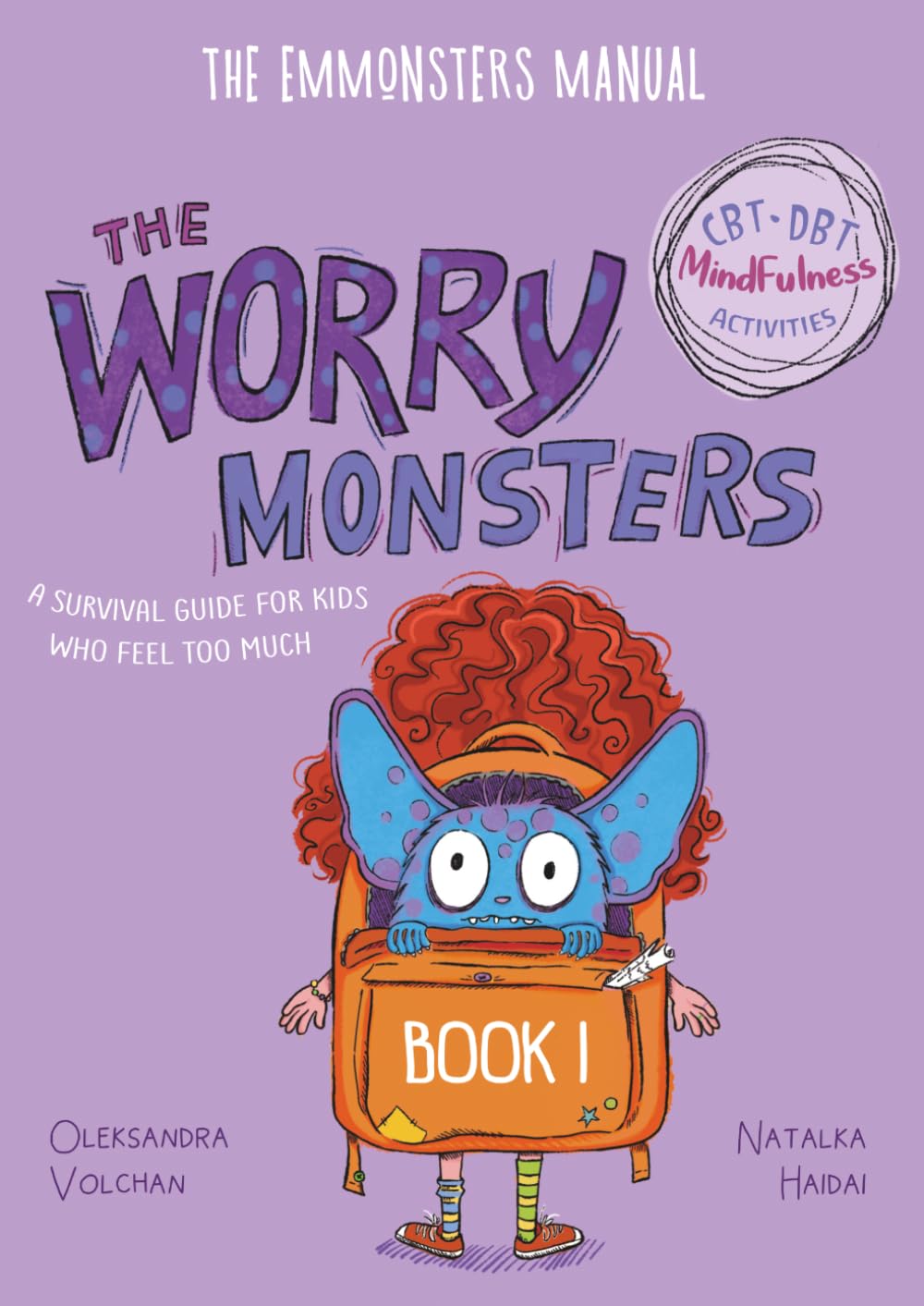
A 50-page illustrated story your class finishes in three sittings — one monster per sitting. The coping skills are inside the plot, not on worksheets, and every scene is mapped below to the five CASEL competencies. No extra prep to justify a read-aloud.
50 pages · 3 read-aloud sessionsCBT · DBT · mindfulnessWritten by a crisis psychologist
The problem this solves
You already know which children in your room are carrying it: the one who checks the door handle three times, the one who melts down in the corridor, the one who erases the same line until the paper tears. What is missing is not concern — it is a shared vocabulary, twenty minutes long, that the whole class can use.
It is a story, not a workbook
Nothing to photocopy, nothing to mark. Children follow Arlin, an eight-year-old who discovers her feelings have bodies and names — and the techniques arrive as things she does, not as tasks they are set.
Built for 7–11, not for 4–8
Most feelings picture books top out at eight. This one is written for children old enough to be embarrassed by their own reactions — which is exactly the age the meltdowns go underground.
Three sessions, three monsters
Whatifon (worry thoughts), Crash-o-Drilla (meltdowns), Perfectopus (perfectionism). Each has its own chapter, profile page and named routine, so a session ends on a tool, not on a cliffhanger.
A shared vocabulary that outlives the lesson
Once a class has met Whatifon, "your Whatifon is loud today" does work that "calm down" never did — it names the feeling without naming the child as the problem.
"As a counselor who works with kids, I like the strategies included to 'defeat' each monster. The book is kind of long so I might read it in 3 different sessions with kids (1 session for each monster.)"
jellymambo · Amazon verified purchase · United States
"A brilliant and lovely book… Very unique and child friendly. It's funny and serious. This would also be a great classroom resource."
Ems · Amazon verified purchase · United Kingdom
Mapped to the five CASEL competencies
Page numbers are from the paperback. Each row gives you the scene, what it teaches, and one question to ask when you close the book — that is the whole prep.
1 · Self-awareness
pp. 14–15 · 18–19 · 20
Pages 18–19 · Whatifon's profile
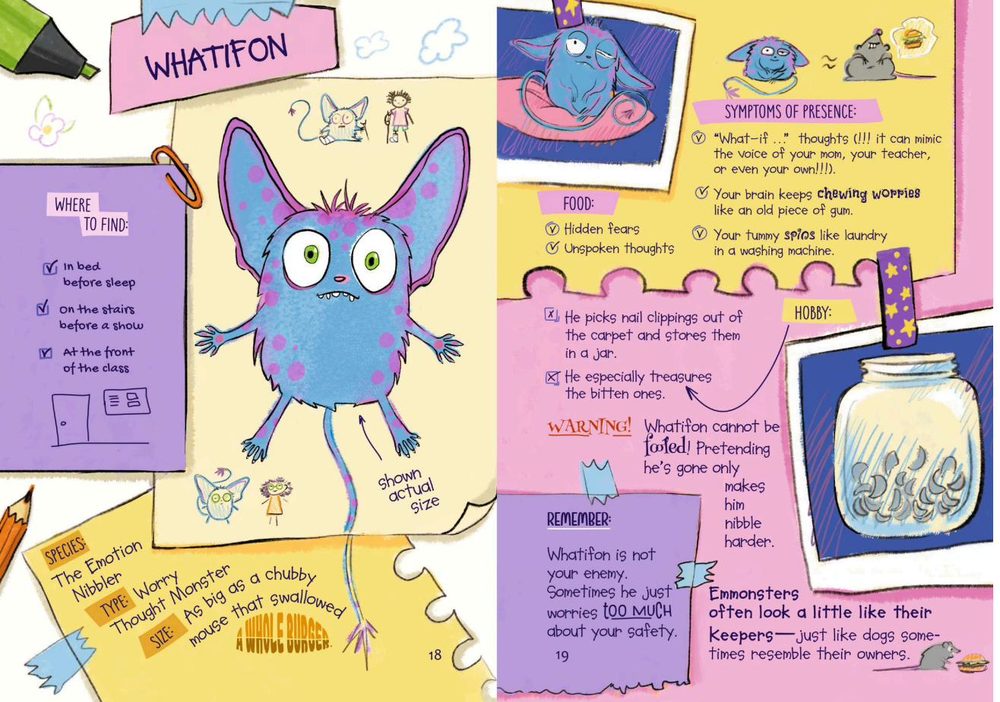
Whatifon's "symptoms of presence" page is a body-scan in disguise: your brain keeps chewing worries like an old piece of gum; your tummy spins like laundry in a washing machine. Then the Monster-Meter asks the child to size the feeling right now — Giant, Sleepy Puff, or Gone. A child who can rate a feeling has already stepped outside it.
Ask the classWhere in your body do you notice your Whatifon first — and how big is he today?
2 · Self-management
pp. 20–21 · 34–35 · 46–47
Pages 20–21 · First aid steps and the Tricolor Sleep Spell
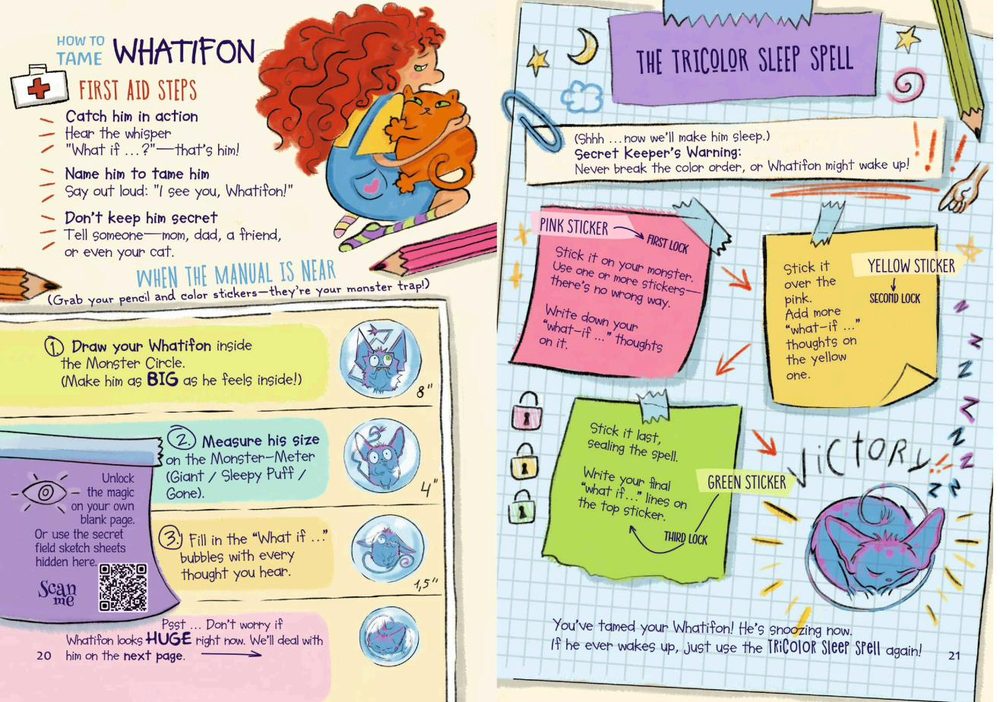
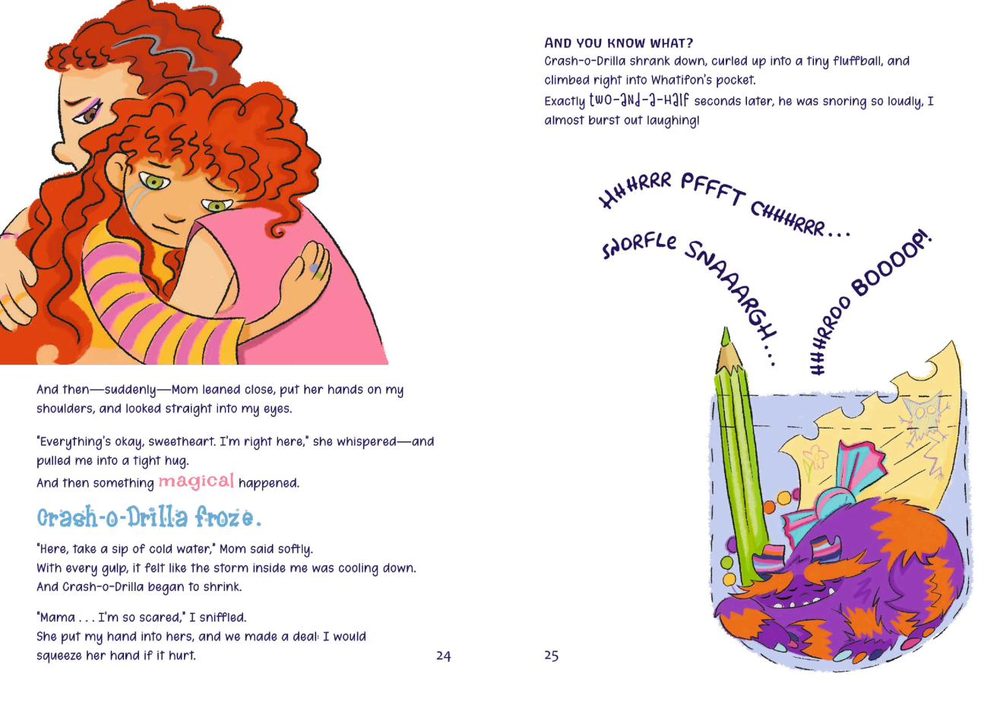
Three named, repeatable routines, one per monster. The Tricolor Sleep Spell: write the "what-ifs" onto three coloured stickers, in order, and lock them down. Cool the Storm: cold water, ice, name the feeling out loud, hug shield — then the Storm Melt Spell, where every written worry is an icy drop that melts the giant. Pause & Breathe and Hand on Heart: "I'm human. Mistakes are okay. They mean I'm trying."
Ask the classWhich of the three spells would you use ten minutes before a test — and why that one?
3 · Social awareness
pp. 16–17 · 23 · 26–31
Pages 16–17 · "I wasn't the only one with a worry monster"
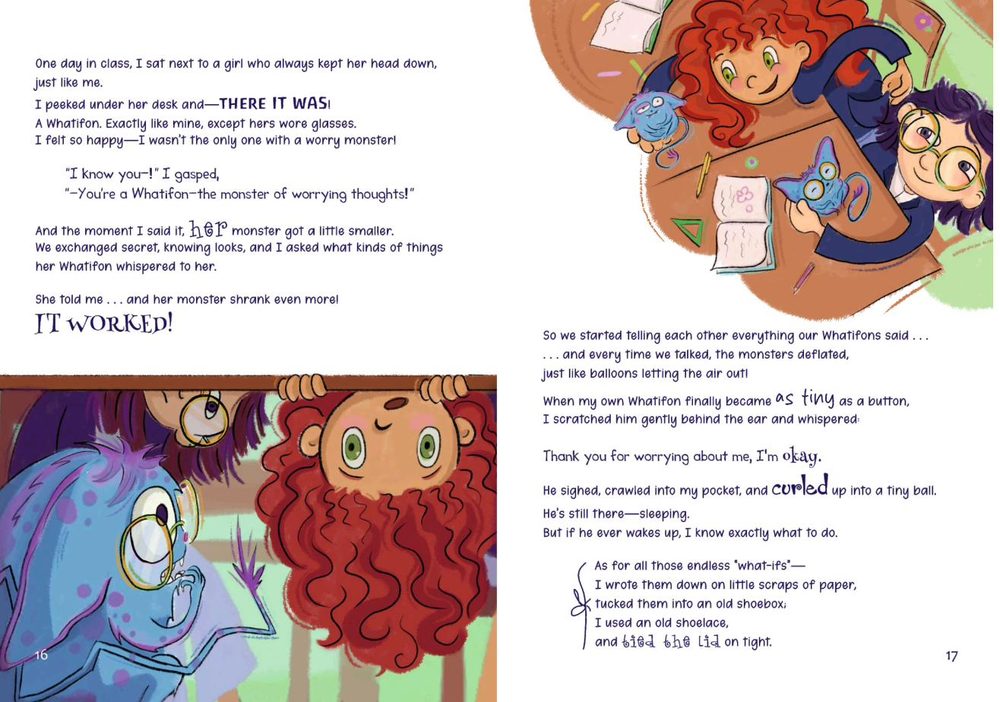
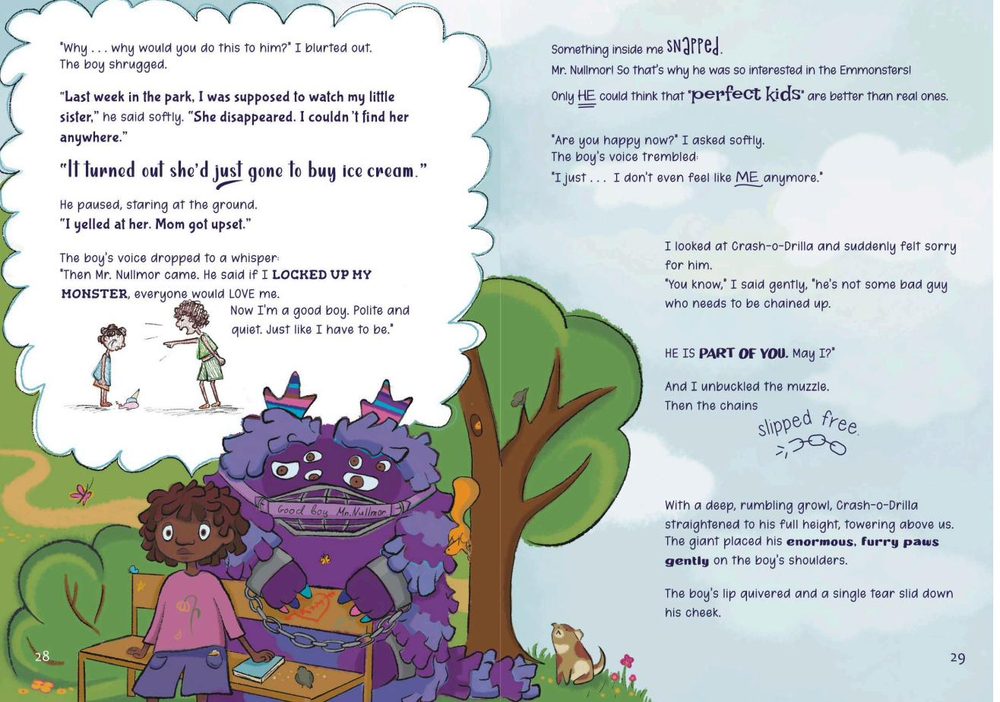
Arlin looks under the desk of the girl who always keeps her head down and finds the same monster, wearing glasses. In the nurse's room an old lady whispers from behind the curtain that she is scared of needles too. And in The Good Boy, the quiet, polite boy on the bench turns out to be sitting in front of a muzzled, chained monster — the class sees the cost of a child who never causes trouble.
Ask the classWhat might you not be seeing when a classmate goes very quiet and very polite?
4 · Relationship skills
p. 20 · pp. 16–17 · 24–25 · 29
Pages 24–25 · The hug, the cold water, and the agreed signal
The first aid steps put help-seeking in writing: Don't keep him secret — tell someone: mom, dad, a friend, or even your cat. Two girls trade what their monsters whisper and both monsters deflate "like balloons letting the air out". Before the blood test, Arlin and her mother agree a signal — she will squeeze her mother's hand if it hurts. And Arlin asks the boy's permission — "He is part of you. May I?" — before she touches his monster.
Ask the classWhat signal could we agree on in this room, so you can tell me it's too much without saying it out loud?
5 · Responsible decision-making
p. 3 · pp. 28–29 · 39 · 42–43
Pages 28–29 · "I don't even feel like ME anymore"
The book opens by handing the reader a choice — close it, or turn the page. It closes that loop with Mr. Nullmor, a charming adult who told a boy that locking his monster away would make everyone love him. The boy obeyed, and says: "I don't even feel like ME anymore." Against that, Arlin backstage, face paint smeared, refusing Perfectopus's "Better NOT at all than like THIS": "I'm not giving up that easy."
Ask the classMr. Nullmor's advice sounded kind. How do you tell advice that helps you from advice that only makes you easier to manage?
Free classroom printables
The monster profiles, the Monster-Meter and the three spells work as loose sheets too — a child who has met Whatifon can draw and size their own without the book in front of them. They are free, and there is nothing to sign up for.
We sell through Amazon only — that is the whole supply chain, and it is why the paperback costs what it costs. One reading copy or a set for the room, it is the same order, and it ships wherever Amazon ships. Book 2, The Anger Monsters, arrives in August 2026.
Oleksandra Volchan is a crisis psychologist, gestalt therapist and certified educator — and the mother of two daughters, one with ADHD. She brought her family through upheaval and an anxiety that, in her words, no workbook could fix, and wrote the book she could not find.
"I didn't write this as a psychologist. I wrote it as a mother who had run out of answers."
Illustrated by Natalka Haidai, by hand. The book states its own limits on the copyright page: it is inspired by cognitive-behavioural, dialectical-behavioural and mindfulness-based practice, and it is not a substitute for professional mental health care.
What this book will not do
It will not replace a referral, and it does not pretend to. A child in crisis needs a professional, not a paperback.
What it will do is give a room of 7–11 year-olds one shared, unembarrassing language for the thing they are all already carrying — and give you three named routines you can point at afterwards, in the corridor, six weeks later.